
Reviews
New York
Dull Chainsaw? SawShark Review: Does It Really Sharpen in Minutes?
Anyone who regularly cuts wood knows the exact moment their chainsaw chain gives up. You hit a hidden rock, graze the dirt, or simply push through one too many hardened oak logs. The saw stops pulling itself into the wood. You find yourself leaning heavily on the bar, burning fuel, and producing a fine, pathetic spray of sawdust instead of those thick, satisfying wood chips. It is incredibly frustrating, especially when you are miles away from a workbench.
For years, the solution meant keeping three spare chains in the truck or sitting on a stump with a round file, trying to manually eyeball a 30-degree angle on 70 individual cutting teeth. Neither option is particularly efficient. Recently, a new manual tool called SawShark hit the market, promising professional-level sharpening power right in your hand. The manufacturer claims it can restore a razor-sharp edge in seconds without electricity or complicated setups.
As someone who values functional, time-saving tools, I wanted to see if this compact aluminum gadget actually solves the dull-chain problem. In this review, we will look at how the SawShark works, evaluate its build quality, and test it on a dull chain to see if the real-world performance matches the marketing claims. We will cover the mechanics of the tool, who can benefit from it the most, and what limitations you should keep in mind before adding it to your kit.
If you are already tired of struggling with a hand file and want to check the current availability, you can see the latest SawShark pricing and up to 70% off discount here.
Understanding the Problem: Why Chainsaw Sharpening Matters
Operating a chainsaw with a blunt chain is a terrible idea for several reasons. It turns a highly efficient cutting machine into a dangerous, motorized friction tool.
Dangers of a Dull Chain
Safety is the most critical factor when running a saw. A dull tooth does not bite into the wood cleanly. Instead, it skates across the surface. This dramatically increases the risk of kickback, which happens when the saw violently jolts back toward the operator. Furthermore, when you have to force the saw downward to make a cut, you lose physical control. If the chain suddenly breaks through the wood, your downward momentum can cause serious accidents.
Inefficiency and Poor Performance
A blunt chain destroys your workflow. The engine has to run at maximum RPMs just to scrape through a log, which wastes fuel and overheats the motor. The bar rails also take a beating. Because the teeth are not cutting a wide enough kerf, the bar rubs against the wood, generating immense heat that can warp the metal and ruin your bar oil lubrication system.
Traditional Sharpening Methods: Pros and Cons
Historically, you had three choices when your chain went dull. You could take it to a hardware store, which costs money and causes massive downtime. You could use an electric bench grinder, which works well but requires taking the chain off the saw, finding an electrical outlet, and risking burning the temper out of the steel teeth if you grind too long. Finally, you could use a hand file. While cheap and portable, hand filing requires significant skill. If you apply inconsistent pressure or angle your file incorrectly, your saw will cut in circles.
First Impressions: Unboxing and Initial Thoughts on SawShark
When you are trying to solve a mechanical problem in the field, you need a tool that can handle getting tossed into a toolbox. Flimsy plastic gadgets do not survive long around firewood processing.
Packaging and Contents
The SawShark arrives in a compact box. Inside, you find the sharpener itself, a wrench, mounting screws, hardware, and mounting pins. The packaging is straightforward and avoids unnecessary bulk. The unit measures just 70mm by 60mm, meaning it will easily fit into a tool belt or the pocket of your work pants.
Design and Build Quality
Picking up the SawShark, the first thing you notice is the weight. At 235 grams, it feels substantial. The body is constructed from a heavy-duty aluminum alloy paired with stainless steel components. This is a massive plus. Tools used in outdoor, rugged environments need this level of durability to withstand drops, sawdust, and bar oil. The threads on the mounting pins (M5 threading) feel cleanly machined, allowing for smooth adjustments without catching or cross-threading.
Setting Up SawShark: Is it Really Simple?
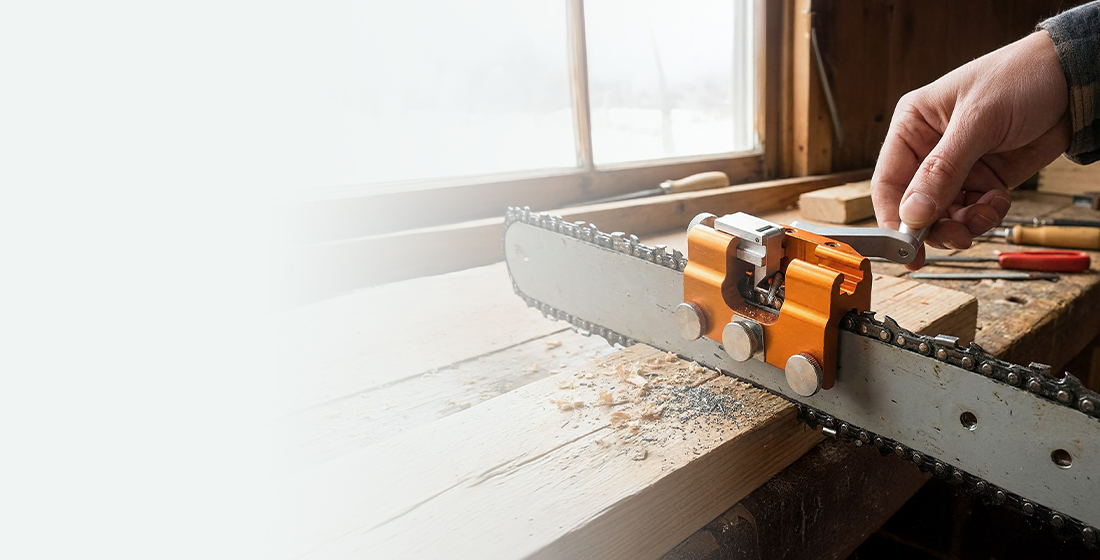
Attaching the tool to the chainsaw bar is highly intuitive. You slide the main body over the chain and tighten the clamp to secure it to the guide bar. You do not need to remove the chain from the saw, which eliminates a major friction point in the maintenance process. Once clamped, it sits firmly in place, ready to go to work on the cutters.
How SawShark Works: The Technology Behind the Claim
The genius of a good tool lies in how it simplifies a complex task. Sharpening a chainsaw tooth requires specific angles—usually 25 to 35 degrees depending on the chain. The SawShark mechanism removes the guesswork entirely.
Explanation of the Sharpening Mechanism
The device functions a lot like a manual pencil sharpener, but built for hardened steel. Once the jig is clamped to the bar, you position the sharpening head against the chain tooth. The tool features built-in angle guides. You simply insert the grinding pin, turn the hand crank, and the tool removes precisely the right amount of metal at the exact right angle. When one tooth is done, you pull the chain forward to position the next tooth, and repeat.
Key Components and Their Functions
The main alloy body acts as a rigid anchor. The guide channels ensure the sharpening head always hits the tooth at a uniform angle. The hand crank provides manual rotational force to the grinding head, giving you total control over how much material is removed. Because you are doing this by hand, there is zero risk of overheating the tooth and ruining the temper of the steel, a common problem with high-speed electric grinders.
Compatibility: What Chainsaws Does it Work With?
One of the most practical aspects of this tool is its universal fit. According to the manufacturer, the SawShark works with all chainsaw brands, bar sizes, and chain types. You do not need to buy specific adapters for your Stihl, Husqvarna, or Echo saws. If you run multiple saws with varying pitches, this one tool covers your whole fleet.
If you are ready to stop wasting time with hand files, you can secure your SawShark directly from the official store here.
Putting SawShark to the Test: My Personal Experience
A tool can look great on a workbench, but the true test happens when there is wood to cut. I attached the SawShark to a 20-inch bar holding a thoroughly abused chain that had recently met the dirt.
Step-by-Step Sharpening Process
I clamped the alloy body onto the bar and adjusted the pawl to rest against the first cutter. I inserted the grinding head through the guide sleeve. Turning the handle felt smooth. The tool provided gentle resistance as the grinder bit into the steel. I gave it a few cranks, pulled the chain to advance to the next tooth on that side, and repeated the motion. The built-in guides forced my hand to maintain the perfect angle.
Sharpening Time: Does it Sharpen in Minutes?
The marketing materials state you can sharpen a saw in seconds or minutes. Realistically, doing a single tooth takes about three to five seconds of cranking. For a standard chain, you will spend roughly three to five minutes completing the entire loop. This is significantly faster than meticulously hand-filing each tooth and checking your angles. More importantly, it is vastly faster than driving to a shop.
Before and After: Visual and Performance Assessment
Visually, the freshly ground teeth had a bright, clean, uniform edge. Hand files often leave varying hook angles if your technique is sloppy. The SawShark produced identical cutters down the line.
I took the saw out to a seasoned oak log. The difference was night and day. The saw immediately pulled itself into the wood. I did not have to apply any downward pressure. The exhaust cleared, the engine ran happily at its optimal RPM, and thick, chunky wood chips piled up around my boots. The saw tracked perfectly straight, proving that the left and right cutters were ground evenly.
Practical Use Cases: What I Used the Sharpened Chain For
After the test, I used the newly sharpened chain to buck a cord of firewood and clear out some thick brush around a property line. The edge held up exactly as you would expect from a properly maintained chain. Having the tool in my pocket meant that when I eventually nicked a stone later in the day, I was back to cutting at full capacity in under five minutes.
Who is SawShark For? Identifying the Ideal User
Tools should match the user's workflow. The SawShark fits perfectly into several specific scenarios.
Homeowners and DIY Enthusiasts
If you pull your saw out twice a year to trim branches or clean up after a storm, you likely do not possess the muscle memory required for perfect hand filing. The SawShark eliminates the learning curve entirely. It guarantees you get the geometry right every time.
Occasional Chainsaw Users
Farmers, ranchers, and landscapers who use saws as a secondary tool will benefit heavily from this. When you are fixing a fence line and need to cut a fallen tree out of the way, you do not want to spend twenty minutes fighting a dull chain.
Those Seeking Convenience and Speed
Because it requires no batteries or power cords, the SawShark is the ultimate field-ready tool. You can sharpen your saw deep in the woods right on the tailgate of your truck.
If this sounds like a fit for your workflow, you can grab the SawShark while it is currently in stock.
Who Might SawShark Not Be For? Realistic Expectations
No tool is universally perfect for every single operator on the planet.
Professional Loggers or Heavy-Duty Users
If you run an industrial logging operation and process dozens of chains a night in a workshop, a high-end electric bench grinder is still your best bet for bulk processing. Interestingly, though, professional arborists (like Freddy B. in the customer testimonials) do keep these in their trucks for quick field touch-ups.
Users Seeking a "Factory New" Edge
While the SawShark gets a chain incredibly sharp, a brand new chain out of the box has a microscopic factory edge that is very difficult to replicate outside of a manufacturing plant. The SawShark gives you a highly aggressive, practical sharpness that cuts beautifully, but do not expect magical factory replication.
Those Who Prefer Manual, Precision Sharpening
Some old-school woodsmen treat hand filing as an art form. If you enjoy sitting quietly in the shed, feeling the file bite the steel, and manually setting your depth gauges, this jig might remove the tactile satisfaction you enjoy.
Key Benefits of Using SawShark
From a functional standpoint, the tool delivers on several crucial fronts.
Speed and Efficiency
The time saved by not removing the chain from the bar is substantial. Cranking a handle is an ergonomic, low-effort motion compared to pushing a file repeatedly.
Ease of Use and Accessibility
The system is foolproof. The guide dictates the angle. Even if it is your first time maintaining a saw, you can achieve a professional-grade result.
Extending Chain Lifespan
Electric grinders often remove too much material, grinding away half the tooth in a single pass if you press too hard. Because the SawShark is hand-cranked, you only remove the bare minimum amount of steel necessary to expose a sharp edge. This means your expensive chains last significantly longer.
Improved Safety
By keeping your hands clear of the cutting edge and providing a guided motion, the risk of slicing your finger on a neighboring tooth is drastically reduced. Furthermore, maintaining even teeth prevents the saw from pulling to one side and kicking back.
Addressing Potential Limitations and Considerations
To maintain an objective view, let's look at the practical realities of using this jig.
The "Razor Sharp" Expectation vs. Practical Sharpness
Marketers love the term "razor sharp." You are not shaving your face with a chainsaw tooth. You want a durable, sharp edge that shears wood fibers without chipping. The SawShark delivers excellent practical sharpness. The teeth will bite hard and pull wood effortlessly.
Durability of the Sharpening Stone
The grinding heads are wear items. Like a hand file, they will eventually lose their grit after repeated use. The alloy body will last a lifetime, but you will occasionally need to replace the burrs depending on how much rock and dirt you try to cut through.
Learning Curve
While much easier than hand filing, your first chain might feel slightly clumsy as you learn how to adjust the pawl and align the pin. By the time you start sharpening your second chain, the process will become muscle memory.
To experience the efficiency of this guided sharpening system, click here to order your SawShark with a 30-day guarantee.
Value Proposition: Is SawShark Worth the Investment?
A good tool should pay for itself in time and saved materials.
Cost-Benefit Analysis
Taking a chain to a local hardware store for sharpening usually costs money and gas, plus the time wasted dropping it off and picking it up. Buying replacement chains constantly is even more expensive. The SawShark completely eliminates shop fees.
Comparison to Professional Sharpening Services
Shop sharpening uses heavy machinery that aggressively grinds teeth down. While sharp, your chain comes back with a shorter lifespan. The SawShark gives you comparable cutting performance while preserving the metal on your chain.
Long-Term Savings
With the current promotional discount offering up to 70% off, the initial purchase price is low enough that the tool pays for itself the first two or three times you use it instead of buying a new chain.
Final Verdict on the SawShark Sharpener
Maintaining your equipment shouldn't be a frustrating chore that keeps you from getting work done. After looking closely at the mechanics, the build quality, and the real-world application of the SawShark, it clearly solves a major problem for people who cut wood.
The heavy-duty alloy construction ensures it can survive the harsh reality of outdoor work. The built-in angle guides completely remove the guesswork that ruins so many chains during hand filing. By allowing you to leave the chain on the saw and simply crank a handle, it turns a tedious, twenty-minute maintenance task into a quick three-minute touch-up. Your saws will run safer, cut straighter, and last longer.
If you are tired of leaning on a dull saw and want to restore your cutting power efficiently in the field, this tool is highly recommended.
Check stock availability and claim your up to 70% off SawShark discount today.